
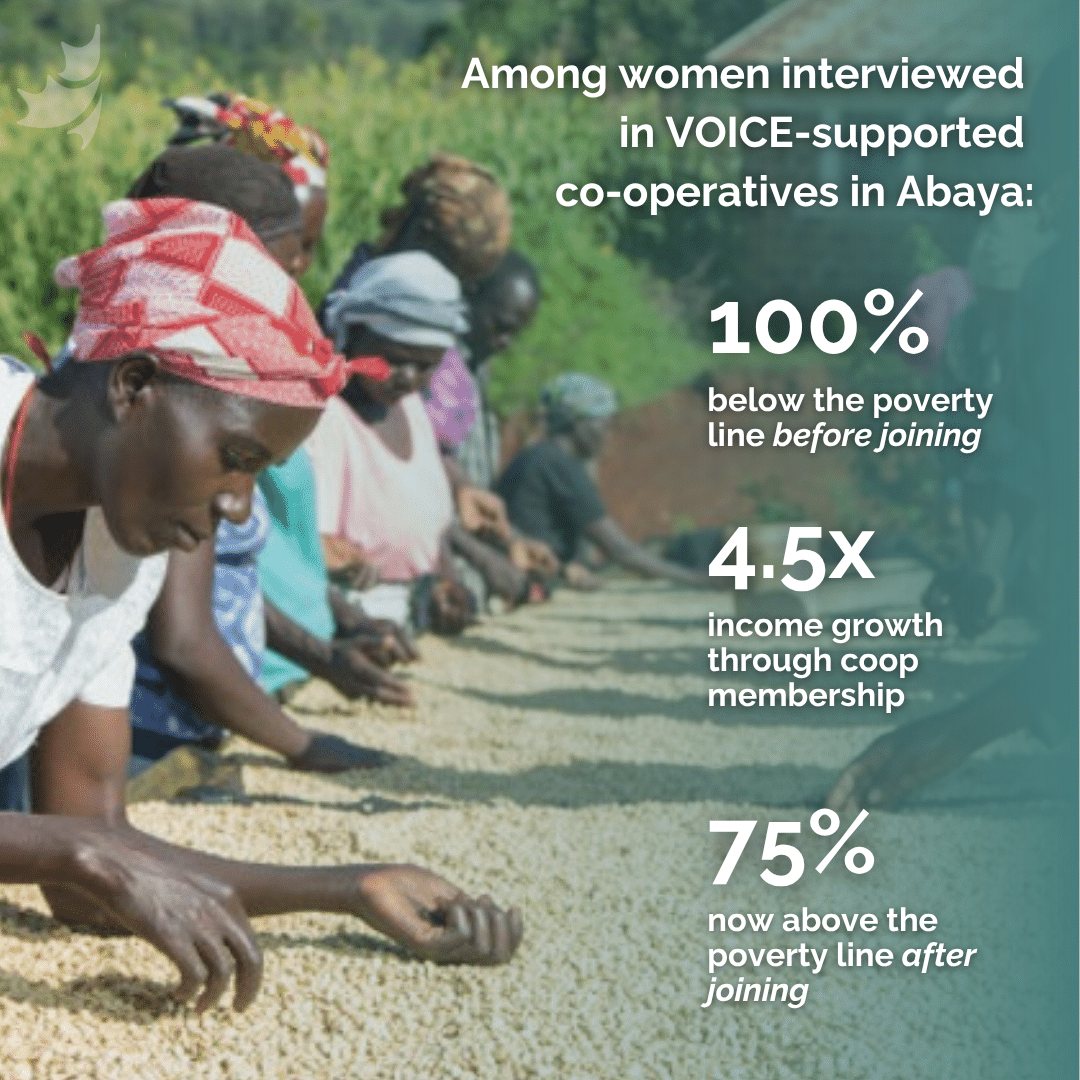
Before joining their local co-operatives, the women in Abaya were operating at the very edge of survival. Income was inconsistent, opportunities were limited, and there was little room to plan beyond immediate needs. Every woman interviewed in the region was living below the international poverty line.
Through the support of the VOICE program and the capacity-building efforts delivered in partnership with local organizations—this reality is beginning to shift in measurable ways.
Nic Megelas, CDF Canada’s Women’s Economic Empowerment Advisor Volunteer, conducted an in-depth field assessment to better understand how co-operatives are contributing to women’s economic advancement in the Abaya region. What emerged was a clear and compelling pattern: co-operatives are not only increasing income, they are reshaping women’s ability to participate in and benefit from their local economies.
On average, women’s incomes increased more than fourfold after joining a co-operative. This growth is driven by a diversification of income-generating activities, including petty trade, livestock rearing, and small-scale enterprises. Where once all participants fell below the poverty line, today, up to 75% of co-operative members are earning above it.
This shift reflects the strength of the co-operative model: locally rooted institutions that combine access to financial services with practical training in business management, financial literacy, and income generation. Women are not only earning more, they are building more stable, reliable, and resilient livelihoods.
Nic’s assessment plays a critical role in this process. By identifying both areas of progress and persistent gaps, his work ensures that future programming is grounded in evidence and responsive to the realities women face. It is through this kind of hands-on, peer-driven knowledge exchange that CDF Canada and its partners continue to strengthen co-operatives as engines of sustainable, inclusive economic development.
For the women of Abaya, this transformation is about more than income. It is about stability, opportunity, and the ability to shape their own economic futures and those of their families and communities.